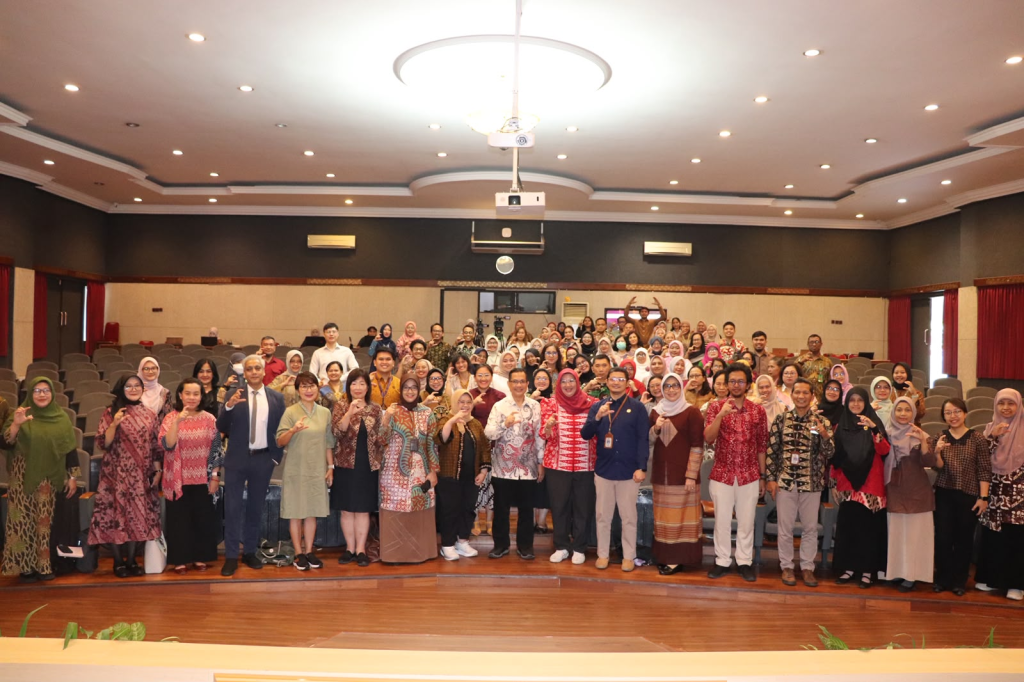
On 4–6 May 2026, nearly 100 participants spanning surgical oncologists, nurses, radiographers, pathologists, patient navigators, community health workers, policymakers, government representatives, and breast cancer survivors came together in Yogyakarta for a-three day workshop. The goal: build a concrete plan to improve breast cancer care in their city. The Breast Cancer Action Plan Workshop marked a major milestone for the Yogyakarta Breast Cancer Initiative (YBCI), Indonesia’s first city-level programme dedicated to strengthening how breast cancer is detected, diagnosed, and treated.
Launched in February 2026, under C/Can Horizon, the YBCI brought together five institutions committed to a unified response to address breast cancer care: the Yogyakarta Special Region Provincial Health Office, Dr Sardjito Central General Hospital, Universitas Gadjah Mada’s Faculty of Medicine, Public Health and Nursing (FK-KMK UGM), and the Health Offices of Yogyakarta City and Sleman District. They recognised that real improvements for women living with breast cancer in Yogyakarta can only be possible through cross-institutional commitment.
The initiative is aligned with WHO’s Global Breast Cancer Initiative (GBCI) Framework, as well as Indonesia’s National Cancer Action Plan (2024–2034), and Indonesia’s Breast Cancer National Action Plan launched in February 2026. The GBCI framework organises action around three pillars: 1) health promotion for early detection 2) timely breast diagnosis and 3) comprehensive breast cancer management. These are the foundations on which the Yogyakarta Breast Cancer Action Plan is being built.
With the Faculty of Medicine, Public Health, and Nursing (FK-KMK) serving as the local implementation partner and providing strong secretariat support to facilitate local participation, C/Can joins as a technical partner, working hand in hand with local health authorities and institutions to drive the YBCI forward.
For FKKMK UGM, the initiative underscores the importance of sustained collaboration among policymakers, healthcare providers, academic institutions, development partners, and communities to ensure that evidence, policy, and implementation are effectively connected to improve outcomes for patients.
Yodi Mahendradhata, Dean of the Faculty of Medicine, Public Health and Nursing, Universitas Gadjah Mada
From Gaps to Solutions
Facilitated by C/Can Horizon alongside the WHO Country Office, the workshop was grounded in the YBCI Situation Analysis; a needs assessment of breast cancer care across Yogyakarta covering detection, coordination, and clinical management. Participants worked through the evidence together: identifying where the gaps are across each of the three GBCI pillars, agreeing on priorities, and designing the interventions they will be responsible for delivering.
Recurring themes during the workshop highlighted the critical need for stronger regulatory clarity, improvement of diagnostics practices towards international standards of care, expanded patient navigation systems, implementation of multi-disciplinary team (MDT) approaches, overcoming language and literacy barriers in patient communication, and more sustained cross-sector collaboration beyond the workshop setting.
This initiative demonstrates translating global guidance and national commitments into action-planning at the sub-national level is both possible and essential. To ensure the plan is implemented to deliver real impact for at-risk population and cancer survivors, strong local leadership and effective multisectoral collaboration are critical. As the first city in Indonesia to implement this approach, Yogyakarta is setting a bold example for other cities and regencies to follow.
Dr Fransiska Mardiananingsih from WHO Indonesia.
Next Steps
Based on the outcomes of the workshop, stakeholders will now proceed in developing a comprehensive City Breast Cancer Action Plan (C-BCAP) fully aligned with Indonesia’s Breast Cancer National Action Plan. An implementation strategy for breast cancer care in Yogyakarta, outlining how the city will move from planning to delivery, will follow the C-BCAP.
Yogyakarta is the first Indonesian city to go through this process. The approach being used here is one that other cities across Indonesia can learn from and adapt. As the initiative moves into implementation, supported by UGM and C/Can Horizon, Yogyakarta’s experience offers a practical blueprint for what it takes to translate national cancer goals into real improvements for patients and how city-led action can achieve this vision.
What makes Yogyakarta’s experience particularly significant is the strong local ownership that has been fostered across government, healthcare institutions, academia, civil society, and patient communities, all of whom have collectively shaped the initiative’s priorities and direction. As the first city in Indonesia to implement this approach, Yogyakarta is demonstrating how national commitments and global guidance can be translated into coordinated local action, while generating valuable lessons for implementing Indonesia’s Breast Cancer National Action Plan and the WHO Global Breast Cancer Initiative.
Dr Gregorius Anung Trihadi, MPH (Chair of the City Executive Committee (CEC) YBCI and Head of Provincial Health Office, Special Region of Yogyakarta