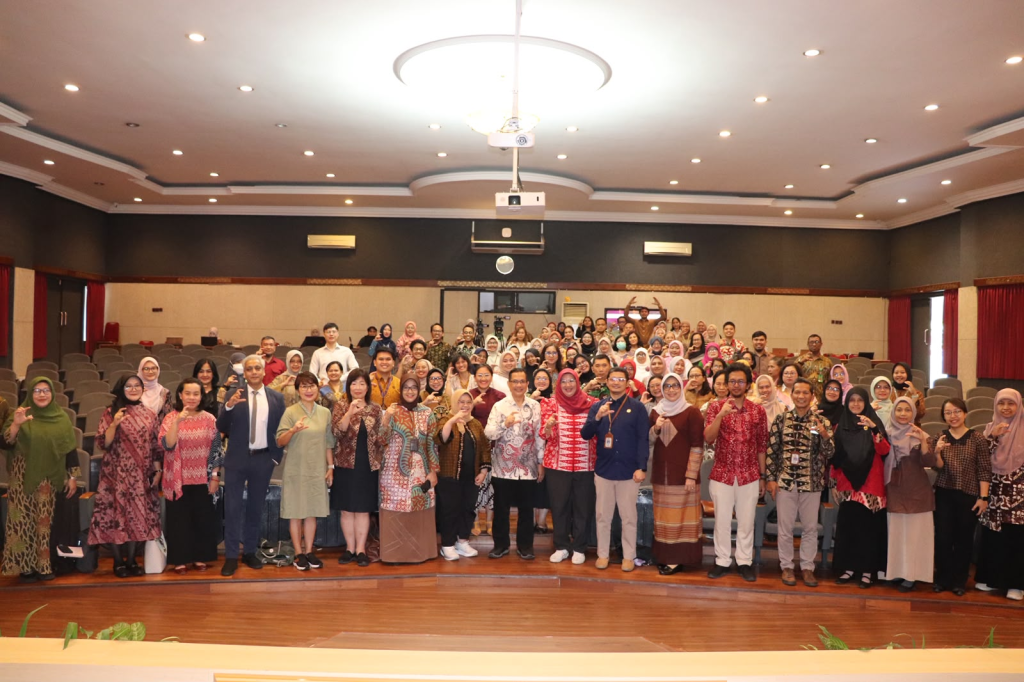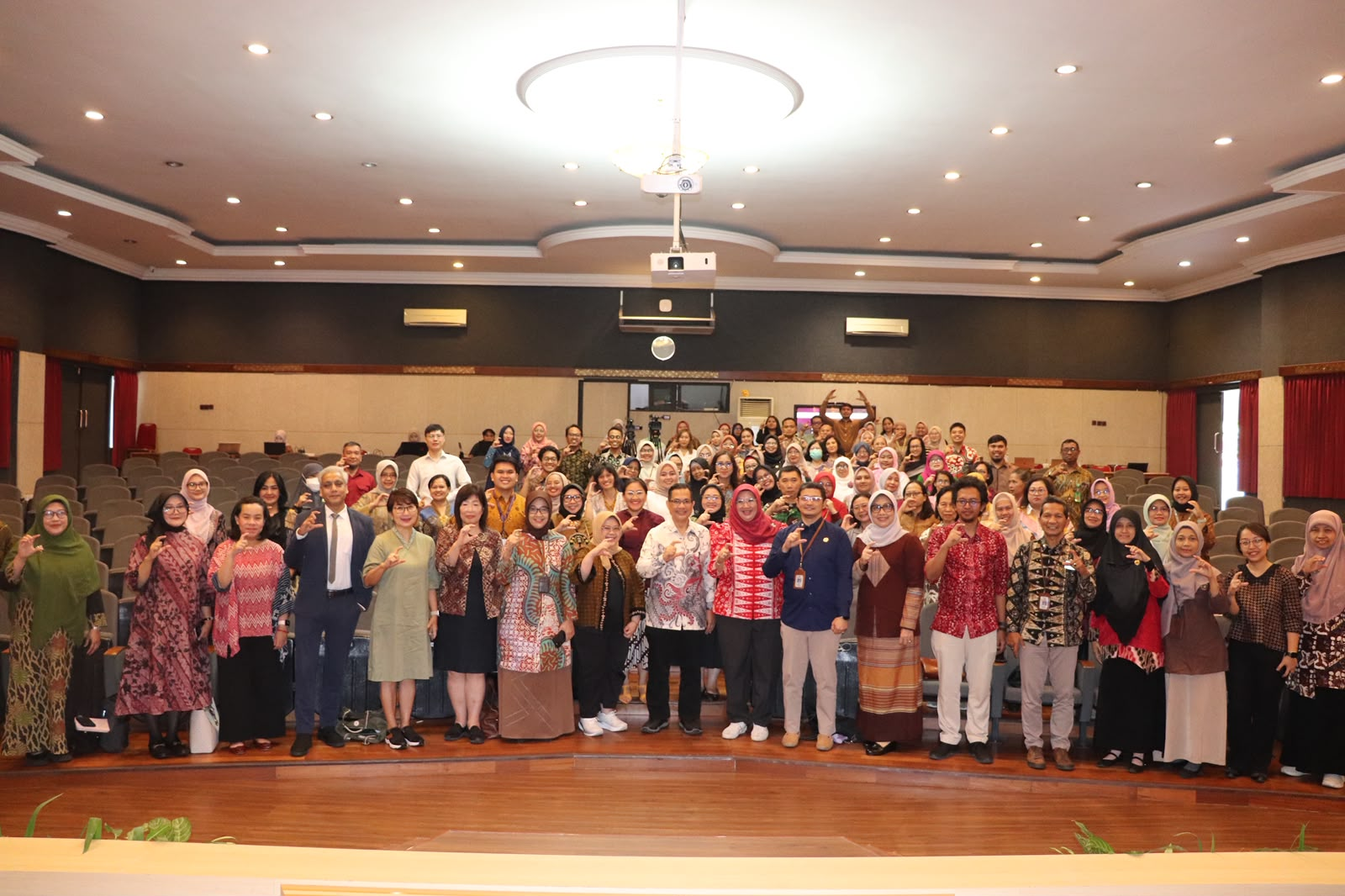
On 21 August 2026, 107 stakeholders from across the city’s health system gathered at the Auditorium of the Faculty of Medicine, Public Health and Nursing, Universitas Gadjah Mada (FK-KMK UGM), with 41 attended virtually, to mark the city’s transition from evidence-based planning to project development, with the dissemination of a localised Breast Cancer Action Plan and proposed solutions to address the city’s immediate needs.
The event brought together government, healthcare providers, academia, civil society, and the private sector to present two outputs: the Yogyakarta Breast Cancer Action Plan (BCAP) and a set of priority projects, ready for the city to put into action, with partners welcome to support delivery.
The foundation for this milestone was laid through a rigorous, evidence-based approach. The process began with a comprehensive Situation Analysis and city-wide needs assessment, collecting data and insights from 9 hospitals, 6 primary healthcare centres, 3 health offices, 3 civil society organisations, and 52 patients. This effort mapped both the strengths and gaps in the breast cancer care pathway.
To ensure accuracy and local relevance, the findings were validated by technical working groups and the Breast Cancer Working Group (BCWG). Nearly 100 participants then convened for a three-day, multi-stakeholder Action Planning Workshop to collectively identify and agree on priorities.
These efforts culminated in the creation of the Yogyakarta Breast Cancer Action Plan (BCAP), a locally owned roadmap structured around the three pillars of the Global Breast Cancer Initiative (GBCI): Early Detection, Timely Diagnosis, and Comprehensive Breast Cancer Management.
This whole process was guided by the experience accumulated by C/Can throughout its global partnership with the World Health Organisation for the implementation of the GBCI. Since May 2023, C/Can has been working with a coalition of partners [1] to develop, test and document the implementation process of this technical framework, with the aim to bridge the gap between policy and practice.
Within just six months of launching YBCI, we were able to complete the action planning and project concept development phase. This achievement is the result of a city-wide collaboration, laying the foundation for clear implementation and demonstrating how city stakeholders unite in collective planning. This could not have been accomplished by the Health Office or the hospitals alone.
Dr Gregorius Anung Trihadi (CEC Chair, Head of Yogyakarta Provincial Health Office)
From Plan to Priorities: What Yogyakarta is Ready to Deliver
A plan is only as strong as its path to its delivery. In just eight months, this collaborative process has produced a clear understanding of local needs, the Yogyakarta BCAP, and a set of implementation-ready priorities across the three pillars of the Global Breast Cancer Initiative (GBCI), each one ready for the city to take forward, with partner support able to accelerate the pace.
Early Detection and Stage Shifting: The priority is to build a coordinated early diagnosis programme held by the provincial health, from population awareness and healthcare workforce training to referral systems and access to diagnostic services, integrated with national health financing mechanisms.
Prompt Quality Diagnosis: The focus is on making image-guided core biopsy standard practice through closer collaboration between radiology, surgery and pathology, increasing the use of diagnostic mammography, and activating SPECT/CT and PET/CT services.
Treatment to Completion: Priorities include formalising multidisciplinary team meetings as standard practice across facilities, strengthening quality assurance for breast cancer surgery and systemic treatment, and ensuring national guidelines are implemented, audited and backed by adequate financial coverage.
Together these priorities chart a locally led path to strengthen Yogyakarta’s health system, anchored in local data and consensus.
A Blueprint for Indonesia
The BCAP proves something bigger than its own priorities: a national cancer plan can be translated into coordinated, city-level action, and repeated elsewhere. YBCI was designed from the outset as Indonesia’s first sub-national pilot of the National Breast Cancer Action Plan, and as a Horizon City, built to be a model other cities could replicate and adapt.
C/Can Horizon supports local stakeholders, health authorities, professionals and institutions to turn national plans and global guidance into functioning, coordinated cancer care, and Yogyakarta shows that C/Can Horizon engagements can support a city as it navigates a clear pre-identified need in its health system. Jakarta is set to launch next, carrying the same model into Indonesia’s capital and putting it to work at national scale.
This is what closing the implementation gap looks like in practice: a city that knows exactly what it needs to do next, and has already started doing it, turning a national strategy into something that changes outcomes on the ground.
Chika Kitajima, Regional Director Asia, C/Can
What The Action Planning Phase Leaves Behind
- Local ownership drove the process: with FK-KMK UGM providing secretariat support and the CEC/BCWG structure keeping government, hospitals, academia and civil society at the same table, priorities were shaped collectively anchored in local data.
- Evidence came before intervention: the Situation Analysis, consultations and workshop process meant priority projects were grounded in what the data showed, local competencies and infrastructures.
- Planning was built with delivery in mind: by developing action plan and project proposals with strategic alignment with World Health Organisation’s Global Breast Cancer Initiative (GBCI), Indonesia’s National Cancer Action Plan (2024–2034), and the National Breast Cancer Action Plan YBCI partners moved straight from consensus to investable proposals, allowing for further action to strengthen Yogyakarta’s health system and better breast cancer care.
- The scalability: the governance structure, evidence base and BCAP framework are helping how other cities, like Jakarta for example, can start its own journey.
Insights from the Yogyakarta Breast Cancer Initiatives will feed directly into our national strategies, offering invaluable learnings for replication in other Indonesian cities and the region to improve equitable cancer care outcomes.
Dr Siti Nadia Tarmizi, Director, Non-Communicable Diseases, Ministry of Health of the Republic of Indonesia
Looking Ahead
YBCI’s experience to-date set out to prove that a national cancer plan could become real, city-led action with five ready-to-fund projects and a governance model built to last.
YBCI proves that when policy, clinical excellence, and community leadership come together, global-standard breast cancer care is within reach. As we enter the implementation phase, no single entity can drive this transformation alone. It will take the continued commitment, co-funding, and active collaboration of every stakeholder—government, international agencies, industry peers, and patient advocates—to deliver lasting impact for patients across Indonesia
Sanaa Sayagh, President Director, PT Roche Indonesia
The project proposals are now open for partners to collaborate with the city of Yogyakarta, FK-KMK UGM and C/Can to turn them into a reality and support Yogyakarta’s journey towards equitable and quality cancer for everyone.
This initiative was made possible through the support of Roche Indonesia.
[1] C/Can would like to thank Amgen, AstraZeneca, BMS and MSD for supporting the phase 1 of the global partnership with WHO (2023-2026), and AstraZeneca, Daiichi Sankyo, Lilly, MSD and Pfizer for supporting the phase 2 launched in May 2026.